
How do you use partial products to multiply? This is a common question for educators and parents trying to help their students learn their multiplication facts.

Here’s how I use partial products to multiply and boost students’ fact fluency.
Oftentimes the partial products strategy is first introduced for 2-digit multiplication, but you can actually show students how to use the strategy with single-digit multiplication.
It’s actually important that you do because partial products help students use easy multiplication facts that they already have memorized to find the answer to facts they haven’t memorized yet.
But here’s the cool thing. When students use the partial products strategy on multiplication facts, it helps them make connections between the numbers and the facts.
That means it will be easier for them to commit the facts to memory. No flash cards or timed drills needed.
So let’s get into how do you use partial products to multiply and increase fact fluency.
This is just one part of a full fluency plan. Grab a FREE copy of your full fluency plan in my guide here: The 7 Steps to Ensure Math Facts Fluency
Using Partial Products to Multiply: A Step-by-Step Strategy
Here’s how partial products work for multiplication facts. In simple terms, you break the fact into 2 parts and then you add the parts.

For the partial products strategy, students use multiplication facts they know to find facts they don’t know yet.
Let’s look at an example with 8×8:
I first think of a multiplication fact of 8 that I know. The one that comes to mind first is 4×8=32. That is 4 groups of 8. And I need 8 groups of 8 for 8×8. That means I need to add another 4 groups of 8. 32+32=64, so 8×8=64.
As students think this through, they are making that mental connection that 32+32=64 and now when they see 8×8 they are going to think of 32+32=64. It helps them commit the fact to memory in an effective and meaningful way.
To really help you understand how do you use partial products to multiply, let me show you with another example:
Let’s look at 7×7.
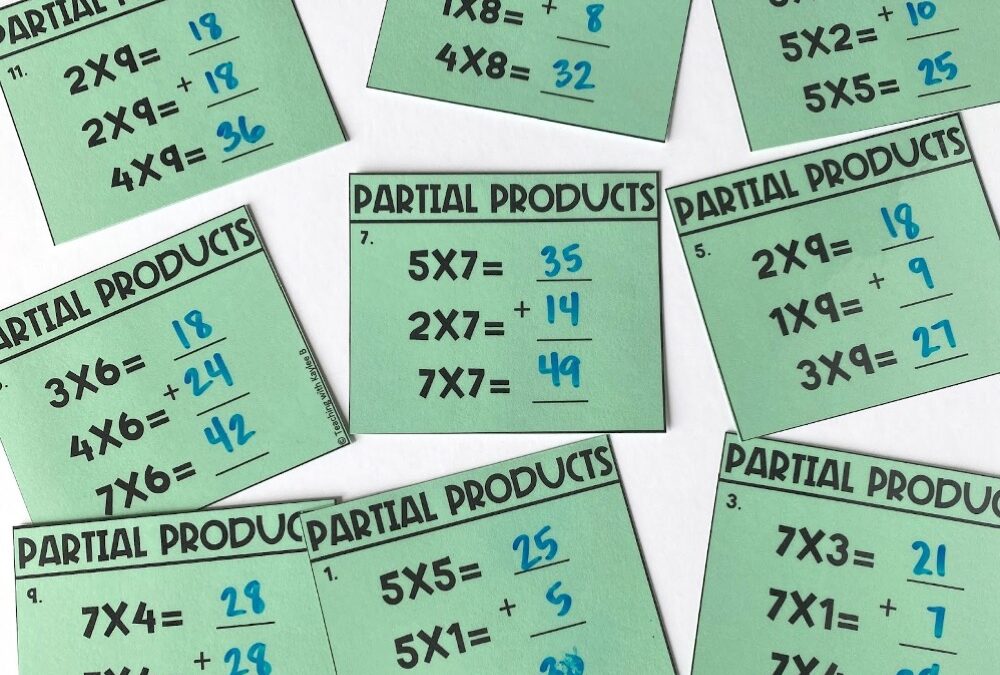
I think of what multiplication fact of 7 I already know. The first one that comes to mind is 5×7=35. That’s only 5 groups of 7 and I need 2 more groups of 7 to get 7 groups of 7. 2×7=14. Now add your partial products: 35+14=49, so 7×7=49.
Find all my lesson materials on teaching the partial products strategy here.
For this strategy to work, students first need to understand the meaning of multiplication.
They need to fully understand that multiplication involves equal groups and that it is repeated addition. I like to teach the meaning of multiplication through different models. Learn how I teach this models in this blog post here: 4 Essential Multiplication Models That Set the Foundation to Fluency
Building on these models, I like to first show students the partial products method with area models.
First Teach Partial Products With Area Models
When I go to teach students partial products, I like to make it a very visual learning experience. I use display pages as slides that show how we can break apart the facts using area models.

When teaching partial products, first show students what the strategy looks like with an area model.
The first page shows a picture of an area model split into 2 sections. Each section is a different color. We write the fact of the top section. Then we write the fact of the bottom section. And to get our final answer, we add those partial products.
We will practice another example where the area model is split for us. But then we move on to examples where the outline of the area model is there, but students get to choose how they break it apart into the 2 facts.
This is where I show students how we want to start with a fact that we already know the answer to. Then we just add the remaining groups to get our final answer.
We practice a couple of these and then we move onto showing the partial products strategy with an array.
The display page shows an array where one fact is marked off. We get that fact and add the other fact to get the answer.
Then we practice some where students choose how they split the array. And some where students draw the array themselves.
But I don’t want students to rely on drawing pictures to use this strategy. These models just help students see why they do what they do when they use partial products.
So we want to take away the models and then just use numbers. And with enough practice, students are able to use partial products as a mental strategy.
I first show students 2 equation frames stacked on top of each other. Underneath I put the equation we are trying to solve.
We need to get our first equation so I ask students for a fact of the number they already know. Then we think of how many more groups we need and write our second equation. And after that, we add the partial products to get our final answer.
I like to get students practice all together, but then it is time for them to get practice by themselves. To do this, I have students complete partial products multiplication worksheets.
Partial Products Multiplication Worksheets
Remember, I use area modes and arrays to first introduce this strategy. I give students partial products multiplication worksheets that get students practice with these. It’s best to give students a worksheet and display it on the board too. Then you can do a couple problems together and then have students do the rest by themselves.
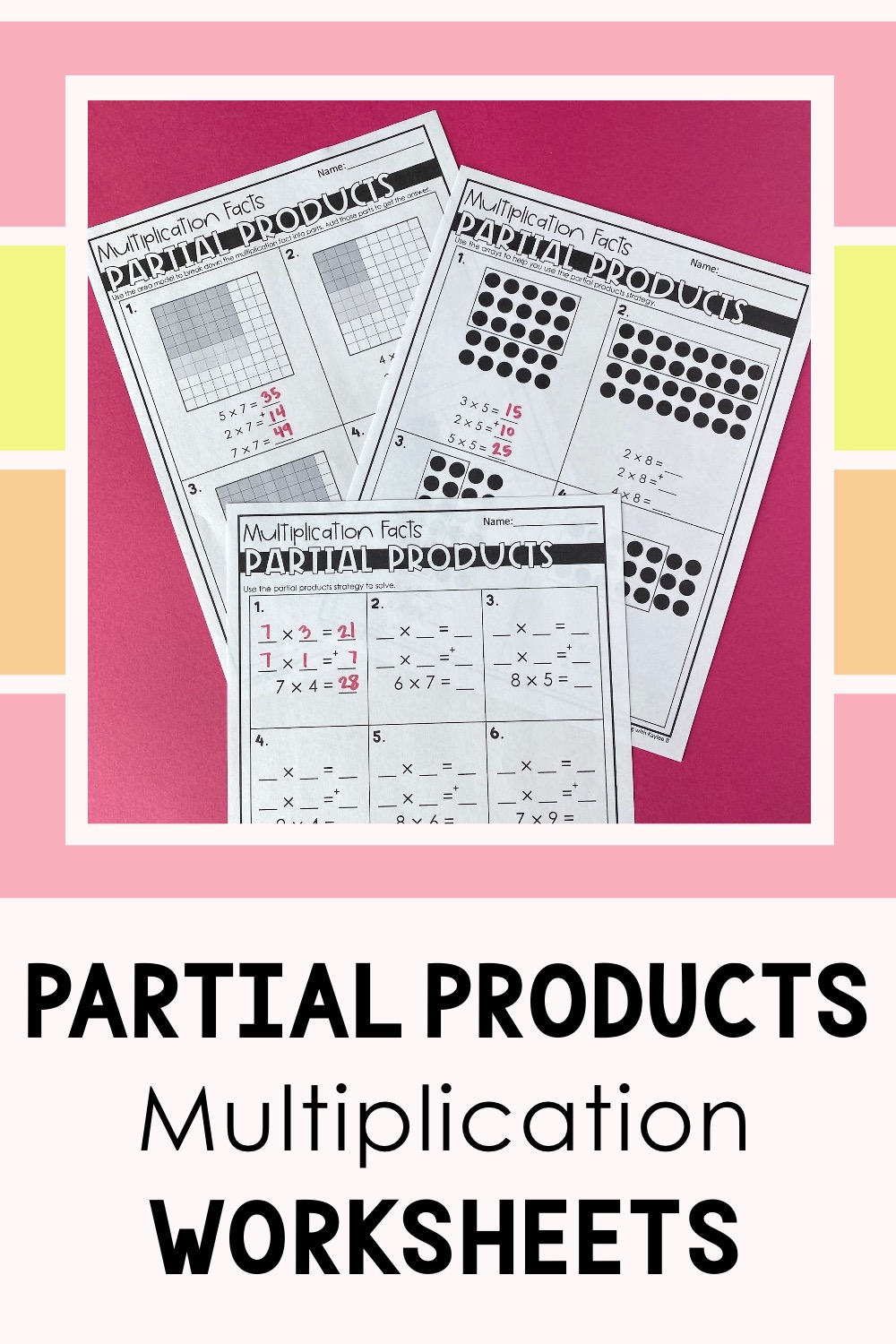
These partial products multiplication worksheets give students the needed practice to master this strategy.
I like to walk around while students are working and give any support or help needed.
Then I’ll give students another worksheet where students are just working with the numbers. The worksheets have the equation frames so that they get help thinking about what facts to split it into.
Again, I’ll give students the worksheet and display the same one on the board. We will do a couple problems together and then I’ll let students do the rest by themselves.
To help give students more support during this time, I display a partial products anchor chart.
Partial Products Anchor Chart
I keep a Partial Products Anchor Chart up all week to support students as they transition from models to mental math. It includes an example with an array and the 3 supporting equations so they always know how to break it down.

Use this partial products anchor chart for students to refer to when they need help using the strategy to solve multiplication facts.
Then after students finish that worksheet, I like to give them a partner to work with on some other extra practice activities.
The first activity is a scoot activity. I tape up task cards around our classroom. The task cards have the partial products strategy with area models. Students go around and write the equations and answer on a recording sheet.
Then students do a partial products puzzle activity. Students work together to line up an array that represents solving a fact with partial products. They line up that picture with the matching equations and answer.

This puzzle helps students practice with the partial products model.
It’s nice to have my parietal products anchor chart up while students do these extra practice activities so they can refer to it when they need help.
And finally, I’ll have students complete an exit ticket by themselves. I’ll review these after school and take note of which students could use a little more practice.
For the students that do need more practice, I like to give them task cards that I have laminated. That way they can use dry-erase markers on them. These have the 3 equations on them so students have to multiply and then add up the partial sums to get the final answer.
So how do you use partial products to multiply and increase fact fluency? You introduce it using models, get students guided practice through worksheets, and then get them extra practice with engaging activities.
Ready to teach the Partial Products strategy with confidence?
Grab the full resource here.
You’ll get:
- Display pages
- Worksheets for models & numbers
- Task cards, scoot game, puzzles
- Anchor chart & exit tickets
Or grab the whole Multiplication & Division Strategy Bundle here.
You may have some other questions about how you use partial products to multiply. So I thought it would be helpful to go over some frequently asked questions I have gotten from teachers.
When should I teach the partial products strategy?
I recommend introducing it after students have learned the meaning of multiplication and mastered easier facts. It’s the last multiplication strategy I teach after Doubles & Doubles, Half Then Double, and One More Set, because it pulls everything together and gives students a flexible tool for the facts they haven’t memorized yet.
Do I need to use models first?
Yes! Models help students see the strategy. But over time, you’ll move toward using just numbers and mental math.
How does this strategy help with fluency?
It helps students break facts into parts they know so they can reason through facts they haven’t memorized yet. Over time, they remember the whole fact.
Is this just for 2-digit multiplication?
Nope! While often taught later, this strategy is great for building single-digit fluency in a meaningful way.
If you’re ready to try out the partial products strategy in your own classroom, I hope this post gave you the tools (and confidence) to get started.
With the right visuals and a little extra practice, your students really can master their multiplication facts in a way that makes sense.
And if you want all the materials done for you, be sure to grab the full strategy pack or save big with the bundle. That way, you’ll have everything you need to make fact fluency click.
