

If your students are struggling with the 6 times table up to 100, there’s one strategy that can change everything and it works for the 8 times table too. It’s called Half Then Double, and it helps students solve tough facts in seconds. And the best part, they don’t need flashcards or timed drills.

When students are learning their 6 times table up to 100, teach them the Half Then Double Strategy.
In this blog post, I’m breaking down how to best teach this Half then Double strategy so that your students can easily learn multiplication facts of 6 and 8.
But let’s first talk about strategies. I have found strategies to be more effective than drilling students on timed tests or flash cards. When students use strategies, they are making mental connections between the facts and numbers. This makes it so they naturally commit the facts to memory, or be able to solve it in a few seconds or less.
Want to see how this fits in a full fluency plan? Grab my free 7 Steps to Ensure Math Fact Fluency here.
What Are the 6 and 8 Times Tables?
We know multiplication deals with equal groups. So if we have 6 equal groups, that’s a multiplication fact of 6. And if we have 8 equal groups, that’s a multiplication fact of 8.
Since 6 and 8 are even numbers, we can have students break the fact in half. This gives them an easier equation to work with. Then they just need to double the answer to that equation. This gets the answer to the fact of 6 or 8.
This strategy can actually work with facts of 4 as well. But I prefer the Double and Double Again Strategy for facts of 4. Read more about that strategy here.
Just to make sure you understand the Half Then Double Strategy, let’s break down this strategy more with some examples.
6 and 8 Times Table Trick: Half Then Double Strategy
For this example, let’s first look at 6×6. First we half it, so instead of thinking about 6 groups of 6, we are going to think of 3 groups of 6. 3 groups of 6 is 18.
Then we double 18. 18+18=36, so 6×6=36.
Now let’s look at an example with an eight times table, 8×6.
- Half the groups.
- Instead of 8 groups or 6, we will think of it as 4 groups of 6. 4×6=24
- Then double: 24+24=48
This is a powerful strategy because our brains love to double numbers. After getting lots of practice, when students see 8×6, they will quickly think of 24+24=48. They will either commit the fact to memory or will be able to solve in just a few seconds. And they are building number sense and meaning behind the fact. No rote memorization needed.
Ready to teach the Half Then Double Strategy? Find all of my lesson materials for this strategy here. It’s for 6 times tables up to 100 and 8 times tables.
Need a little more support? Let me share exactly what I do to teach this strategy.
How to Teach Multiplication Facts of 6 and 8 with the Half Then Double Strategy
I start with direct instruction. This is where I explicitly show students how to use the Half Then Double strategy.
I want to do this in a way that builds meaning and makes it visual for students. So I use display pages. I project these up on the whiteboard and use them as slides.

The half them doubles strategy works for teaching six time tables and eight times tables.
A set model is a really great way to introduce this strategy. So I show a slide with a set model that is split in half. We get the half equation and then double to get the answer. Then we can even do repeated addition with the set model to double check our answer.
But I want to build even more meaning, so I show students what this strategy would look like with an area model.
The area model is split in half with 2 different colors. We get the area of the top part. This is the halving part. Then we double that answer to get the answer. Again, we can use repeated addition and add up the rows to check our answers.
Learn more about the different multiplication models in this blog post here: 4 Essential Multiplication Models That Set the Foundation to Fluency
But I don’t want students to rely on drawing pictures of models to solve 6 time tables up to 100 and 8 times tables. So then I show the strategy with just numbers.
I do this with a repeated addition equation. We block together half of the numbers in the equation. That is us halving the equation. Then we double that to get our final answer.
And after that, I just put up equations of 6 times tables and 8 times tables, we walk through the strategy without models and without writing out the repeated addition equation.
But just showing students the strategy isn’t enough for students to memorize the 6 time tables up to 100. So I also get students guided practice, independent practice, and extra practice.
Printables to Practice the 6 and 8 Times Tables
Worksheets are great for guided practice. I give students a worksheet and project the same one up on the whiteboard. We solve a couple problems together and then have students do the rest as I walk around helping and giving support.

Teach the meaning behind 6 times tables and 8 times tables with these printable worksheets.
I have worksheets that follow the display pages. Students start with a worksheet with set models, then area models, then repeated addition equations, then just the equations.
After that, students are ready for independent practice. I give them another worksheet but this time they complete it by themselves. Students come to me when they finish and I review their work with them.
Then I partner students up and give them some extra practice activities. These activities can work for centers as well.
The first activity is a scoot activity with task cards. The task cards are taped up around our classroom. Students go around and write the equation that matches the picture. The picture is the Half The Double strategy with set models and area models.

The Half Then Double strategy is more than a six times table trick. It helps students make connections and commit the facts to memory. These task cards give students the practice they need with the strategy.
I do have a set of task cards that I laminate and students write on them with dry-erase markers. These have the repeated addition set up so they really support students. These are great for centers.
After students complete the scoot activity, I have them do a puzzle activity. The puzzle shows the set model split in half. Then students have to up the halving equation, the doubling equation, and the fact and answer that matches the set model.
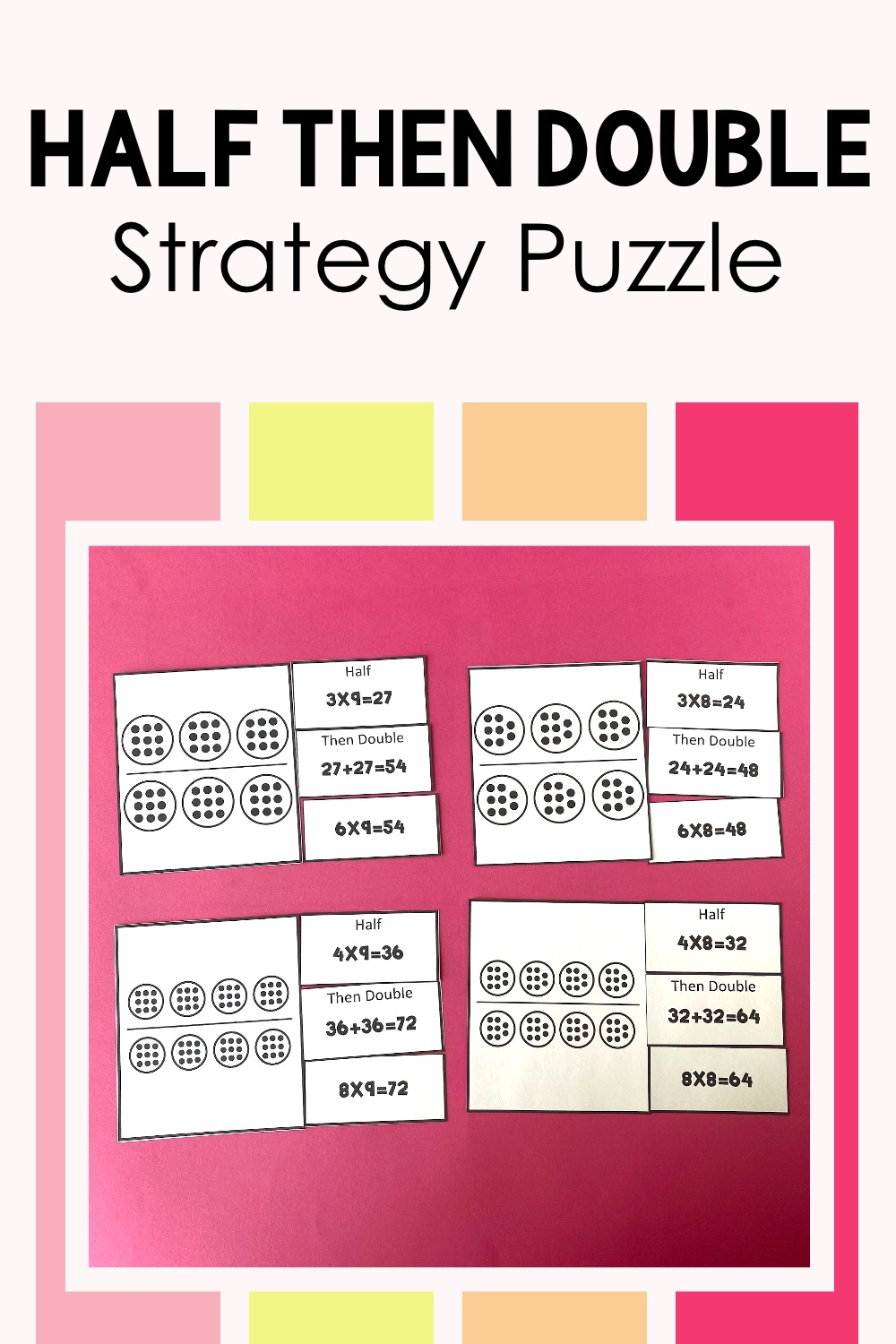
Get students hands-on practice with 6 times tables and 8 times tables with this printable puzzle.
I love having students work together for these activities because it gets them talking about the math out loud. This helps solidify their understanding even more.
And finally, I have students complete an exit ticket. I check these later and take note of who could use a little more practice.
You may still have some questions for this strategy on 6 times tables up to 100 so let’s go over some frequently asked questions I get from teachers.
When should I teach 6 times tables and 8 times tables?
This strategy is great for 3rd grade students and for older students who are still struggling with mastering multiplication facts.
Here’s the order I like to teach multiplication facts. I’ll first start with teaching what multiplication means. I do with the models and word problems.
Then I teach easy multiplication facts. These are facts of 0, 1, 5, 9 and 10. Learn more in this blog post here.
After that, I teach double facts and the double plus one more set strategy. This helps students learn facts of 2 and 3. Learn more in this blog post here.
And then students are ready to learn multiplication facts of 4.
After that we teach a strategy to help them learn facts of 6 and 8. Then I teach a strategy that helps them figure out any multiplication fact. Learn about all these strategies in this blog post here: 9 Proven Multiplication Strategies That Build Lasting Fluency
How can this 6 times table trick help my struggling students?
It will make it so multiplication facts of 6 and 8 aren’t so scary anymore. They can use this simple strategy or trick to solve. As they work with the different models, they will be meaning behind the facts and behind multiplication. This will increase their number sense, helping them in all aspects of math.
What’s the best way to teach 6 time tables up to 100?
It’s a strategy-based approach. The Half Then Double strategy helps students discover the answer to facts by themselves. This makes it so they can naturally memorize the facts without needing to be drilled again and again by timed tests or flash cards.
For the best path to follow to help your students master all math facts. Grab your free copy of my workbook: 7 Steps to Ensure Math Fact Fluency
Hope you have found this blog post helpful. I can’t wait for you to teach this strategy to your students!
Final Thoughts on 6 Time Tables up to 100
Multiplication facts of 6 and 8 don’t have to be intimidating for your students or you. The Half Then Double strategy gives them a visual way to solve facts quickly and confidently.
By building meaning through models and scaffolding the practice, your students won’t just memorize facts… They will understand them.
Ready to Teach the 6 and 8 Times Tables with Confidence?
Grab my full Multiplication Facts Strategy Pack for 6 & 8. it includes display pages, scaffolded worksheets, task cards, games, and more.
Get the resource pack here.
Or find it in a money-saving bundle with all my multiplication and division fact strategies here.
