

Struggling to help your students actually remember their multiplication facts? You’re not alone. When it comes to how to learn multiplication facts, flashcards and timed tests only go so far. In this post, I’ll walk you through the strategy-based system I use to build true understanding and fluency in a way that sticks.

Want to help your students learn multiplication times tables quickly? Make sure to teach these multiplication fact strategies.
Our number system is so amazing and there are many patterns we can discover. We can use those patterns as strategies for solving and quickly finding the answer to multiplication facts. Grab my bundle for teaching all of these strategies here.
When students use these strategies, their brains take a certain pathway to solve. As they get more practice with them, those pathways become stronger and faster. Soon they can solve a fact in a few seconds or less, or just commit the fact to memory.
And that’s how to learn times tables quickly and in a meaningful way. It’s not just to pass off a timed test. These strategies bring lasting success. They help build number sense in students that will assist them in higher-level math down the road.
So what are they and how do we teach them?
But first, I have a free workbook that walks you through the best practices of helping your students find fact fluency. Download your free copy here.
How to Learn Multiplication Facts
Here’s the order of how I teach these strategies:
- Meaning of Multiplication
- Easy Multiplication Fact Patterns
- Doubles and Doubles +1 Set
- Double and Double Again
- Half Then Double
- One More Set
- Partial Products
- Fact Families
- Partial Quotients
Most students won’t discover these strategies for themselves. So as teachers, we need to explicitly teach them. They are perfect for 3rd grade students learning multiplication for the first time. But if students are still struggling with fact fluency in 4th grade or high grades, come back to these strategies, teach them again, and get students plenty of practice.

Wondering how to learn multiplication facts? I’m sharing 9 strategies that help your students understand and commit multiplication facts to memory.
To teach these lessons, I use display pages as slides to guide me in introducing them. These are very visual and show the strategies with different models. They guide me on what to say and do. They also give a gradual release of support.
Then students are ready for some guided practice. I like to use worksheets for this. I’ll project the worksheet up on the board so we can do a couple problems as a class. Then I’ll have students do the rest of the worksheet as I walk around giving help and support where needed.
After that, I’ll give students one more worksheet. They do this on their own as independent practice. As they work, I sit over at our classroom table. As students finish, they come line up by me and I quickly look over their work, helping them fix any mistakes. If students feel stuck, they can sit at the table and I go back and forth helping students and checking work.
Then I like to get students additional practice with the strategy. So I have them do a scoot activity with task cards. I tape task cards around our classroom. These show the strategy with models. Then students take a recording sheet, go around to the different task cards, and write the matching equation. I love how this activity gets students up out of their seats and moving. This is also a great activity to have students work with a partner. That way they can support and help each other. Plus, it gets them talking about the math out loud.
Once they are finished with the scoot activity, I have students work with that same partner to complete a puzzle activity on that strategy. The puzzle has different pieces showing the strategy in a visual way with models. Then students match the equations that go with the model.
Finally, I’ll have students complete an exit ticket. I’ll check these later and take note of who can use more practice.
It’s important to note when thinking about how to learn multiplication facts, that these can’t just be one and done lessons.
I like to have a 10 minute math fact center each day. There are 5 centers and students go to just one of these a day. We have a focus strategy each month and our centers revolve around that strategy.
Here are those 5 centers:
- Mini Lesson: I use the display pages to teach the strategy
- Task Cards: students complete a set of task cards on the strategy (I love task cards that I can laminate and students use dry-erase markers on them.)
- Worksheets or Puzzle: I’ll set out a worksheet or a puzzle activity for students to get more practice
- Fluency Fun: Students play a multiplication fact game to practice the strategy naturally
- Technology: I’ll have students play an online game that focuses on multiplication fact fluency
Find my bundle that includes all the resources you need to teach these strategies here.
Alrighty, now that you have seen how I teach these strategies, let’s dive into what these strategies actually are.
How to Learn the Multiplication Table: Teach These 9 Strategies
Meaning of Multiplication
We don’t want to just jump into having students memorize the facts. We first need to teach the meaning behind the facts or what multiplication really means.
What do you want students to learn about multiplication? We want them to know what each number in the equation represents. They also need to understand that multiplication is repeated addition.
How do we do this?
Through models and word problems.
Word problems help them see what each number in the equation represents. Models help them see that multiplication is repeated addition.
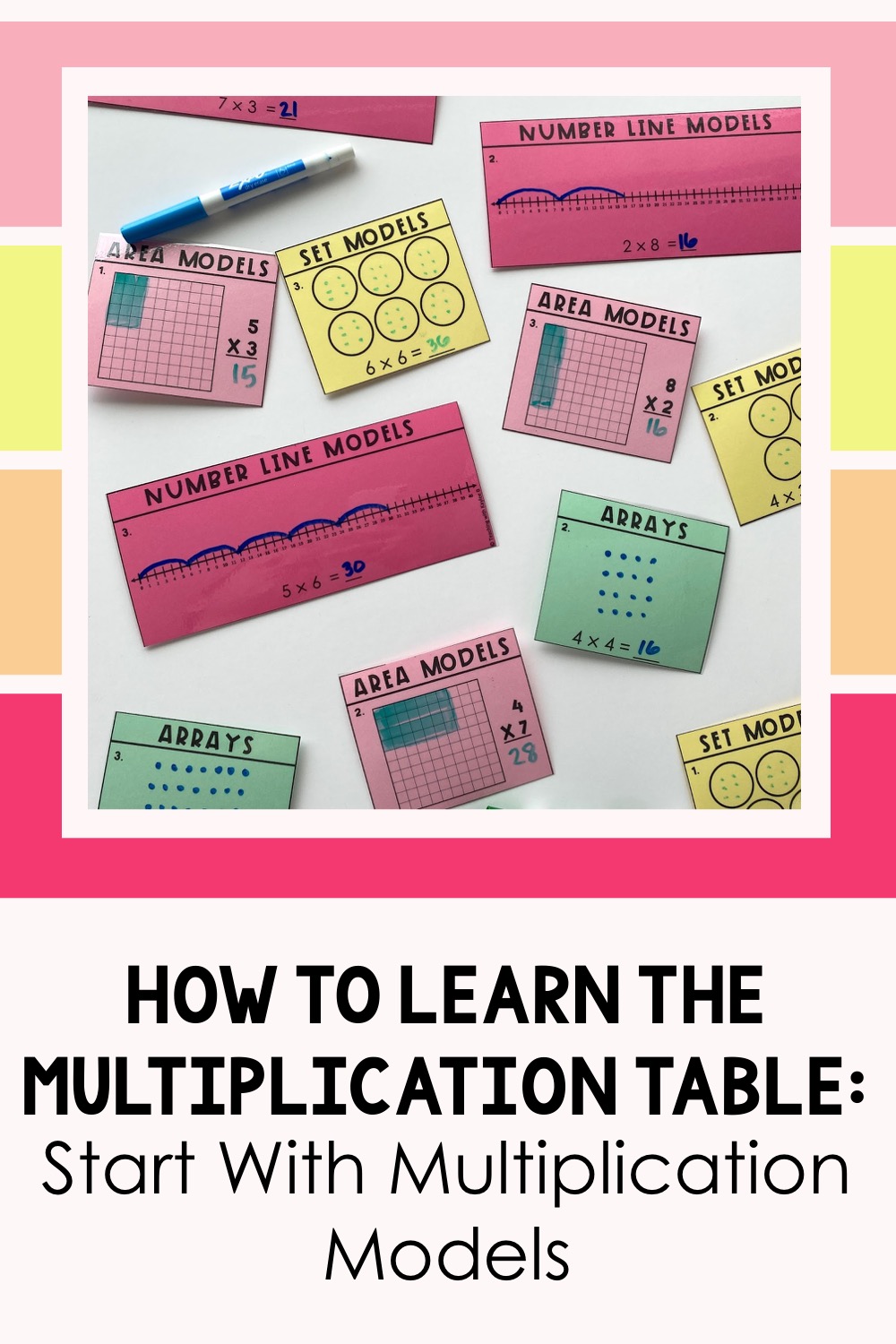
Help students best learn their multiplication tables by starting with multiplication models. These build the meaning behind multiplication so that they can memorize the facts easier.
I give students a word problem and then we use a model to solve. Here are the 4 models I teach:
- Set Models
- Arrays
- Area Models
- Number Line Models
Learn more about these models and how to teach the meaning of multiplication in this blog post here: 4 Essential Multiplication Models That Set the Foundation to Fluency
Grab the full Meaning of Multiplication lesson set here to start teaching this tomorrow.
I heard from a 3rd grade teacher that was tutoring some of her former students over the summer. She used this resource and said this:
“I tutored two students today. Both struggled with multiplication facts and understanding multiplication this past school year. I bought your meaning of multiplication bundle and it has helped them so much. We started with equal groups then worked forward and ended with area. They now comprehend that multiplication is repeated addition. They now use all of the models for figuring out the product of a multiplication fact they don’t know. Especially those trickier multiplication facts. Even word problems. Thank you for this resource! Can’t wait to use them in my classroom this upcoming school year.”
Building the meaning behind multiplication matters. It’s easier for students to commit something to memory when they actually understand what they are being asked to memorize.
So when it comes to how to learn multiplication facts, make sure to start with the meaning of multiplication.
But what do we teach next? We need to teach the patterns for easy multiplication facts.
Easy Multiplication Facts
We want to move on to easy multiplication facts next because these give students quick wins when it comes to memorizing the facts. These are multiplication facts of 0, 1, 5, 9 and 10.
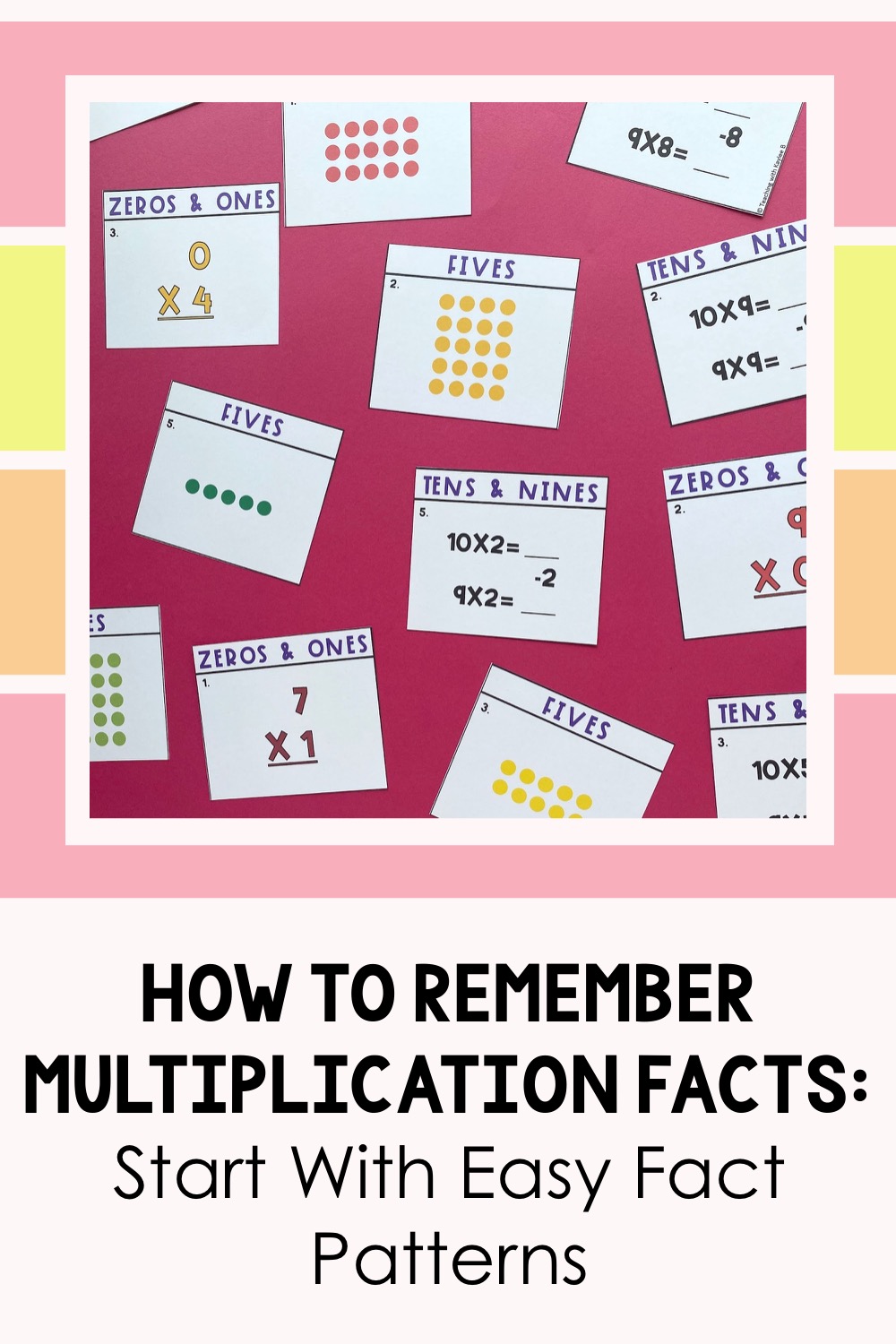
Wondering how to remember multiplication tables easily? Start with easy multiplication facts. These help students use patterns to find quick wins with the facts.
Students catch on these patterns super quickly. I actually like to help them discover these fact patterns. When you discover something yourself, it’s easier for you to remember it.
How do we do this?
By using world problems and models. I can show solving a multiplication fact of 1 by using a set model, then an array, then an area model. Students will quickly learn that when you multiply a number by 1, it is just the number.
I do this with facts multiplied by 0. They discover that the answer is always 0.
We move on to multiplication facts of 5 and students learn they can just count by fives to get the answer.
Then I teach multiplication facts of 10. Students see we can just put a zero on the end of the number.
And then I relate this to multiplication facts of 9. We think of multiplying by 10 and just subtract 9 to quickly get the answer.
Learn more about how to teach these easy facts here in this blog post: Easy Multiplication Facts: How to Teach Them So Students Never Forget
Ready to give your students quick wins with easy multiplication facts?
Find all the materials you need for successful lessons on these facts here.
After teaching the easy facts, I love to teach double facts and multiplication facts of 3.
Doubles & Doubles +1 Set
In second grade, students work to memorize addition double facts. These are facts where you are adding the same number together. Like 4+4, 5+5, and 6+6.
But since multiplication is repeated addition we can represent those double facts as a multiplication fact.
2 groups of 4 is 8. Or 2 times 4 equals 8.
2 groups of 5 is 10. Or 2 times 5 equals 10.
2 groups of 6 is 12. Or 2 times 6 equals 12.
These are double facts. And they can help students find multiplication facts of 3 easily. You just have to add one more set.
So when a student sees a multiplication fact of 3, like 3×4, they can first think of the double fact. 2×4=8. Then just add one more set of 4. 8+4=12, so 3×4=12.

This puzzle is a fun way for students to learn multiplication facts through games and activities.
Learn more on how to teach multiplication doubles facts in this blog post here: Easy Strategies for Mastering Multiplication Facts of 2 in Elementary
When teaching the Doubles +1 Set, I like to first make it very visual. I want students to see the double fact very clearly and then add the additional set. As students get used to that, I take away the pictures and just have them work with the numbers so that it makes it a mental strategy.
Find my lesson materials to teach the Doubles +1 Set Strategy here.
Double and Double Again
Our brains love novelty, and they see double facts as novelty. It’s easy for students to commit double facts to memory. So it’s no surprise there is another strategy where students can use double facts to solve.
The Double and Double Again strategy helps students memorize multiplication facts of 4.

What’s the best way for students to learn multiplication facts of 4? Have them use the Double and Double Again Strategy.
Let’s look at the example of 8×4.
We double 8, 8×2=16. Then we double again 16+16 is 32, so 8×4=32.
I like to show this strategy in very visual ways with set models and area models. For set models I show the 4 sets split in half. Then for area models, I show the area split in half with 2 different colors. After getting students practice with those, I take away the models and have them just work with numbers. This helps the strategy become a mental math strategy.
Find my materials for teaching the Double and Double Again Strategy here.
Half Then Double
This strategy works for multiplication facts of 6 and 8. Here’s how it works. You think of the fact in sets. Take half of those and get the answer. Then double the answer.

Students love to use dry-erase markers on task cards when it comes to how to practice multiplication facts.
Let’s look at an example with 6×7. That is 6 groups (or sets) of 7. Take half of those and you have 3 sets of 7. Well 3×7=21. Then we just double the answer, 21+21=42, so 6×7=42.
Let’s look at another example with 8×6. We can think of this as 8 groups (or sets) of 6. Half of that would be 4 groups of 6, or 4×6. 4×6=24, then we just double that. 24+24=48 so 8×6=48.
Like the strategies before, I like to introduce this strategy in a very visual way with set models and area models. That way students can really see us taking half, and then doubling to get the final answer.
Then I’ll take away the picture and just have students working with the numbers. I like to list the fact out as the repeated addition equation. That way students can easily take half and see what they multiply by and then just double that to get the answer.
This is a strong mental math strategy. As students get lots of practice with these equations they are making mental connections that make it easier to commit the fact to memory.
When students work with 6×7 using this strategy enough, they will start to just associate it with 21+21=42. They can quickly solve it in a few seconds or less, or just commit the fact to memory.
But it takes practice, so find my lesson material for teaching the Half then Double Strategy here.
One More Set
This is a strategy where students take facts that they already have memorized to find facts they don’t have memorized yet.
A student might not know 6×6, but they do know 5×6=30. So they just add one more set 30+6=36 so 6×6=36.

Want to learn how to help students remember multiplication facts? Make the strategies very visual for them.
This one is really easy for students to see with set models. I’ll show 5 sets of 6 all grouped together, then I show another set of 6 next to it. They will get 5×6 quickly and then just add one more set.
Area models are also really good to show this. I show 5 rows of 6 in one color, then one more row of 6 in another color. Students use the known fact and then just add one more set.
After students get the hang of this with models, I’ll have them work with just the numbers. This helps it turn into a strategy they can use mentally.
Find my lesson materials for the One More Set Strategy here.
Partial Products
Partial products is another multiplication fact strategy that helps students use known facts to find unknown facts. But this time they aren’t limited to just adding one more set. They are going to break apart the fact into easier facts. Then add the answers (or the partial products) to get the final answer.

Teach partial products as a multiplication strategy. This helps students use known facts to find the answer to facts they haven’t memorized yet.
Let’s look at an example of 8×8. A student may know that 5×8=40. But that’s only 5 groups of 8. We need 3 more. So 3×8=24. Then you add the answers, 40+24=64. So 8×8=64.
When first introducing this to students, I break apart the equations for them. I also make it very visual by having them look at the facts with set models and area models.
I especially find area models helpful because I can show the facts with 2 different colors.
Then I help make this a mental strategy for students by taking away the models and just having them work with numbers.
And finally, I have them choose how they want to break apart the number.
I get students lots of partial products practice with worksheets, task cards, and puzzles.
Find these materials to teach partial products to your students here.
Fact Families
This is an important strategy for students because once they understand fact families, they can automatically know 3 more facts.
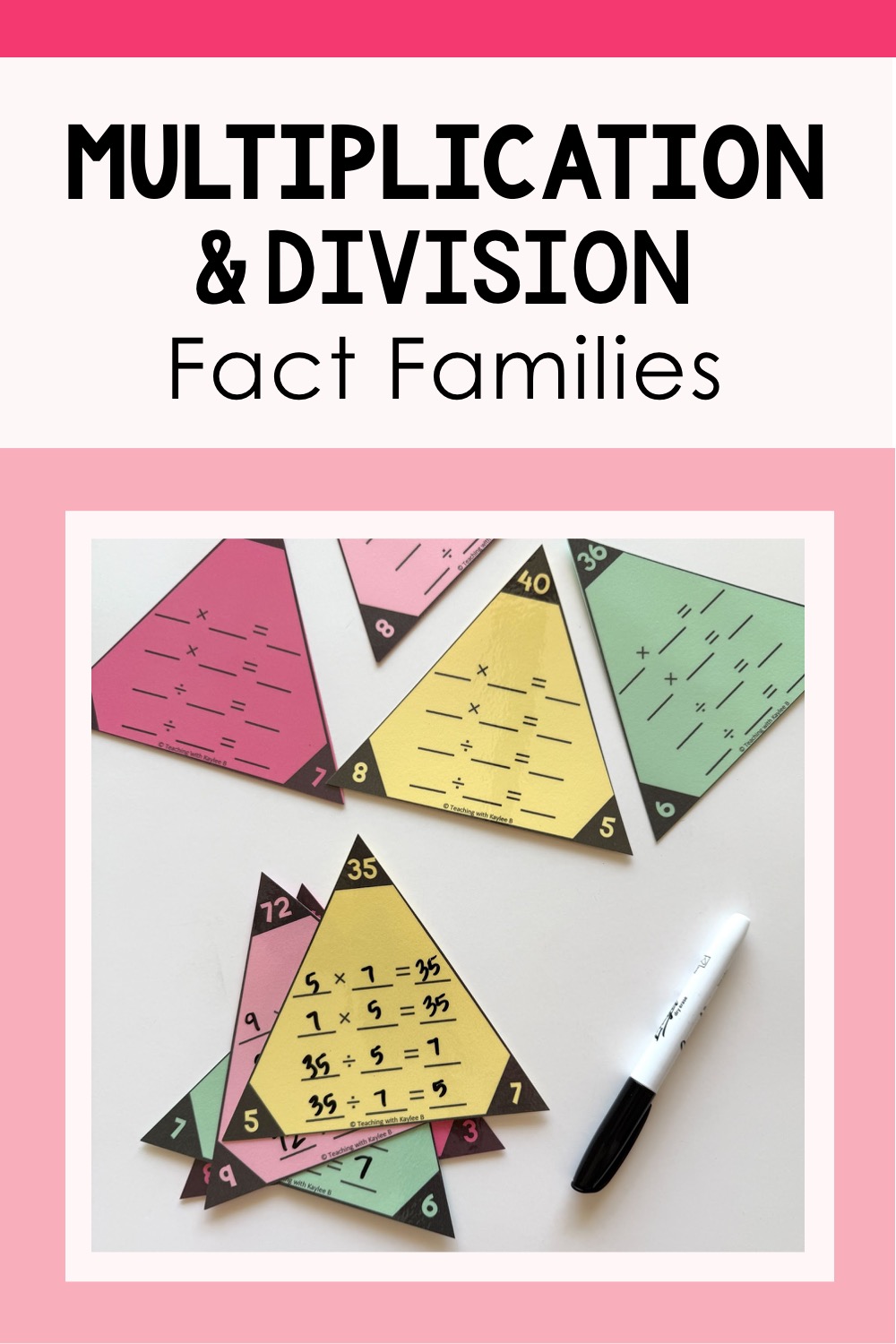
Teach fact families as a division fact strategy. That way students can use multiplication to divide.
Let’s look at an example. If students know 3×4=12, then they can know 4×3=12, 12÷3=4, 12÷4=3.
This is the best strategy to help students learn division facts. They can use multiplication to divide.
If a student doesn’t know 42÷7, then they can think “what number multiplied by 7 equals 42? 6! So 42÷7=6.”
What’s the best way to get students practice with fact families? Fact family triangles.
Each triangle has the 3 related numbers in the corners. Students use those 3 numbers to write the related facts. You can laminate these so students can write on them with dry-erase markers.
It’s great to post a blank one on your math review wall. Each day as part of our math warm up, fill in 3 related numbers and then students give you the 4 matching equations. Start this at the beginning of the school year to promote fact fluency early on.
Find my fact family triangles and other fact family lesson materials to use with your students here.
Speaking of division facts, I’ve got one more strategy that helps students solve these tricky facts.
Partial Quotients
Since multiplication and division are related to each other, partial quotients are closely related to partial products.
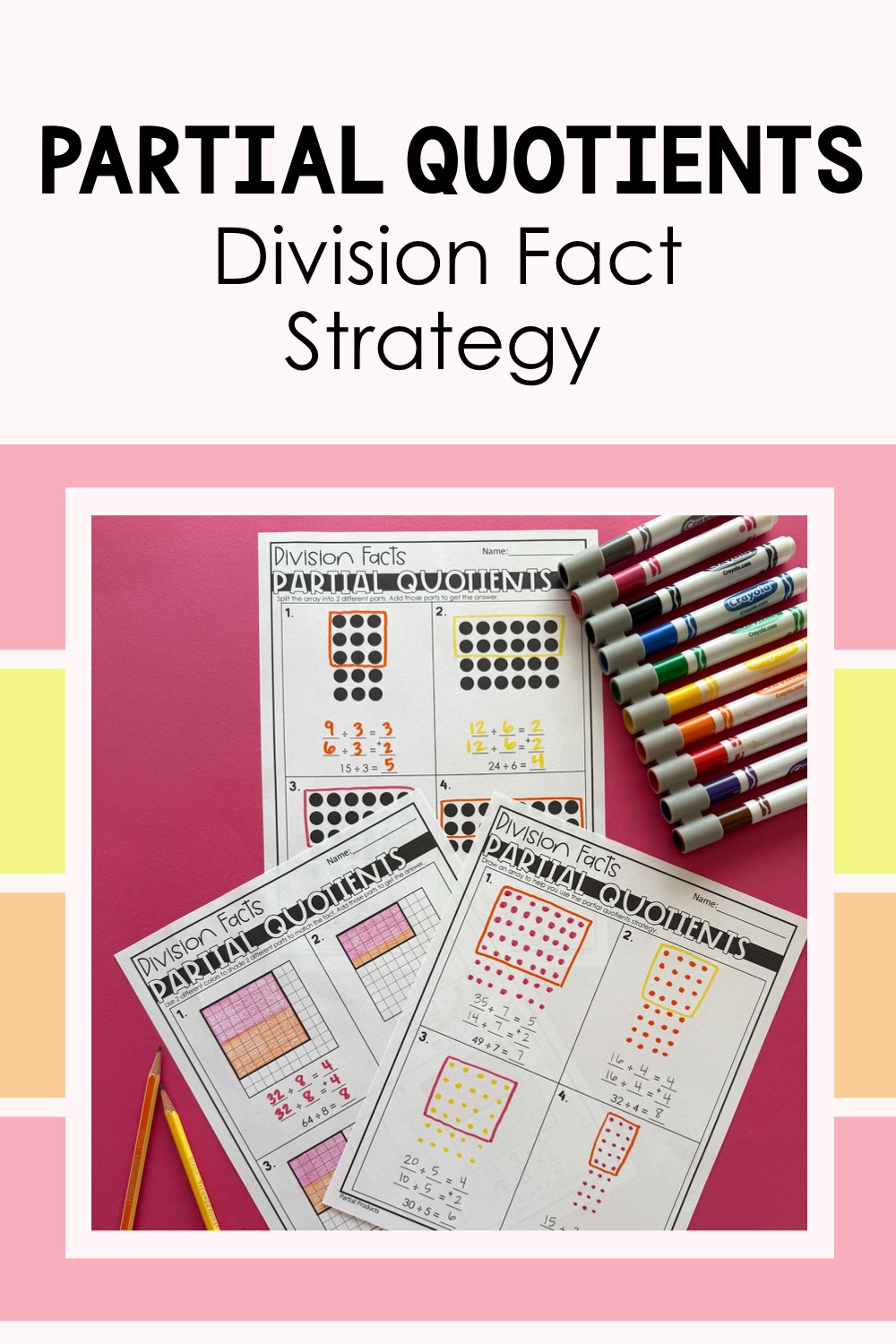
Teach partial quotients as a division fact strategy. That way students can use easy facts to find facts they don’t have memorized yet.
For this strategy, you break apart the division fact into easier facts and then add the answers (or partial quotients) together.
Let’s look at an example with 49÷7. An easy fact of 7 that I know is 35÷7=5. That’s only 35 and we need to get to 49, so what’s the difference? 14. So we divide 14 by 7 to get 2. Then add our two answers, 5+2=7. So 49÷7=7.
You can easily show this strategy in a visual way with arrays and area models. I first help students split the facts apart. Then when they are ready, I’ll take away the pictures, just have them work with numbers, and choose how they want to split into easy equations.
Find my partial quotient lesson materials here.
How to Remember Multiplication Tables Easily
By building the meaning of multiplication with models and word problems, students understand what they are being asked to memorize.
Then we start with the easy facts so that students find quick wins. They start to see that we can use patterns and relationships to easily find the answer to facts.
As we teach students multiplication strategies and get them lots of practice with them, students will build connections between the numbers and facts.
Here are the strategies I teach students:
- Doubles & Doubles +1 Set
- Double and Double Again
- Half Then Double
- One More Set
- Partial Products
- Fact Families
- Partial Quotients
As students learn and work with these strategies, they will be able to solve a fact in a few seconds or less, or just commit the facts to memory. And that’s what we call math fact mastery.
When you follow these lessons, you are also helping students master important 3rd grade math standards. It will set them up for future success with higher-level math.
They won’t get caught up on 2-digit multiplication or long division because they will know their facts fluently.

Want more guidance in getting your students to math fact mastery? Grab your free copy of my workbook: The 7 Steps to Ensure Math Fact Fluency
It has a one-page guide to these strategies which is super handy to have when teaching.
Ready to teach these strategies to your students? Find all of them in this money saving bundle here.
This bundle includes everything you need at a discounted price you won’t find elsewhere.
I get a lot of questions from teachers who use these strategies and lessons in their classrooms. If you’re thinking about using them too, this FAQ section will help you feel confident getting started.
Frequently Asked Questions About Learning Multiplication Facts
What is the best way to learn multiplication facts?
The best way to learn multiplication facts is by using strategy-based instruction that builds number sense and understanding. Instead of relying only on flashcards or timed drills, teach students the meaning of multiplication and introduce patterns and mental math strategies like doubling, halving, and partial products. This helps students develop true fluency not just memorization.
How do I help my students remember multiplication facts?
To help students remember multiplication facts easily, use visual models, real-world word problems, and repetitive practice with strategies like Doubles + One More Set or Half Then Double. Reinforce their learning through hands-on activities, fluency centers, and games. The more meaningful and engaging the practice, the more likely they are to retain the facts.
How can students learn multiplication tables quickly?
Start with easy facts (like 0s, 1s, 5s, 10s, and 9s) to give students early success. Then, layer in multiplication strategies that use relationships and patterns. Practice daily in short bursts, like 10-minute math fact centers, to build fluency over time. Be consistent, and focus on understanding, not just speed.
What are some games or activities to teach multiplication facts?
Some great multiplication fact games and activities include:
- Task card “Scoot” games
- Puzzles that match models to equations
- Dry-erase fluency activities
- Fact family triangle challenges
These make practice fun, visual, and interactive that helps students build confidence and quick recall.
How do multiplication strategies help with long-term math success?
Multiplication strategies help students form mental pathways to solve problems efficiently. By building a strong foundation now, students are more prepared for future math like multi-digit multiplication and division. It reduces frustration and supports higher-level problem solving.
Ready to Help Your Students Master Their Multiplication Facts?
Helping students understand multiplication, not just memorize it, is the key to lasting fluency and confidence in math. By teaching strategies like Doubles, One More Set, and Partial Products, you’re giving your students tools they can use far beyond just a test.
✨ Want a quick-reference guide to all the strategies I teach?
Grab your free guide: 7 Steps to Ensure Math Fact Fluency to get started with strategy-based instruction.
And if you’re ready to teach these strategies with done-for-you lessons, center activities, puzzles, and exit tickets, check out my Multiplication & Division Fact Strategy Bundle.
It has everything you need to teach multiplication & divison facts in a way that sticks.
Whether you’re just getting started or reteaching facts to older students, these strategies meet your learners where they are. Stick with them, and you’ll see progress. Your students can become fluent in multiplication and you don’t have to do it alone. I’m here to help. Grab the free guide here or send me a message on instagram.
