
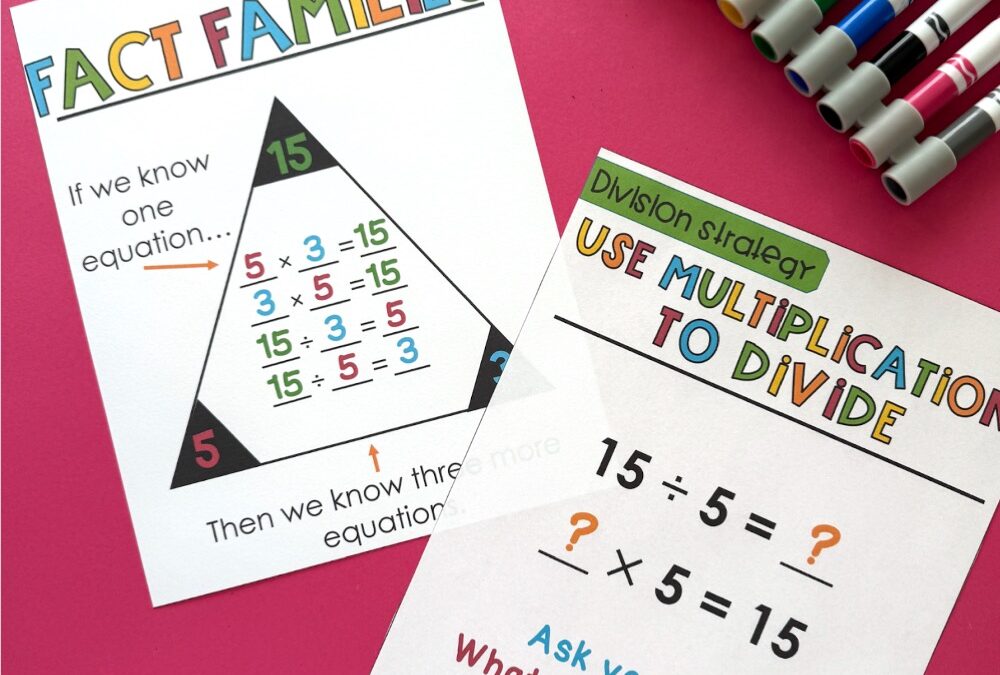
If your students are struggling with fact fluency, they could be missing an essential key to math fact mastery: multiplication and division fact families
Multiplication and division fact families are so powerful because if students just know one fact, like 3×4=12, then they can know 3 more: 4×3=12, 12÷3=4, and 12÷4=3.

Multiplication and division fact families can boost your students’ fluency. Here’s how.
When students understand and can use fact families for multiplication and division, that means they can use multiplication to divide.
This is really important because oftentimes multiplication facts are easier for students to memorize. So as long as they memorize their multiplication facts, they can quickly find the answer to division facts.
Here’s what that looks like: “I don’t know 42÷7, so 7 times what equals 42? 7×6=42, so 42÷7=6.”
Working with fact families is just one part of a full fluency plan. Learn the full plan in this guide here: The 7 Steps to Ensure Math Fact Mastery
But how do students actually get to the point where fact families help them with fact fluency?
Let me break this down with exactly how I teach multiplication and division of fact families.
Find all of my resources to help students quickly learn fact families here.
How to Teach Multiplication and Division Fact Families
In short, I like to have students write out the fact family equations that match all the different multiplication models. Then I show how they can use that relationship between multiplication and division to solve division facts they don’t have memorized yet.
I like to use display pages for this. These are slides that walk us through direct instruction. They provide a very visual learning experience for students. But before this lesson, students do need to understand what the multiplication models are. Learn more about teaching those in this blog post here. And they need to understand the meaning of division. Learn more about teaching that here.

Show students what is a fact family multiplication.
The first display page I show has an array of counters. I ask students how many counters they see. They might count up 12 or add up the rows or columns to get 12.
The next page shows that same array but it also shows a part-part-whole diagram and the matching multiplication equation for how many rows are in the array. We multiply how many rows by how many are in each row to get 12.
Then I show the next page that again has the same array. But this time we focus on columns. I show the equation of the number of columns multiplied by the number in each column to get our total.
Students have just discovered the commutative property of multiplication, meaning that the order of the numbers being multiplied does not change the product. Or if they know one multiplication fact, they automatically know one more now.
But we want to take it a step further and show the division facts for this same array. So I show the next page that as the array and then we write the equation with the total number of counters, divided by the number of rows, equals how many are in each row.
We still need our last division equation, so I show the next page with the same array. But this time we focus on columns. We get our total number of counters, divided by the number of columns and this gets us the number in each column.
To hone in that these 4 equations are related, I show another slide with the same array and the 4 equations and the filled in part-part-whole diagram. From this same part-part-whole diagram, we made 4 different equations.
Then it’s time to show this with different models. So the next slides show area models, number line models, set models, and bar models. Together we fill in the part-part-whole diagram and write the 4 related equations.
Now here is the important part that will boost your students’ fact fluency. We need to then show how students can use fact families to use multiplication to divide.
So I show different part-part-whole diagrams where one number is missing. Then I get students the equation frames where there is a blank for that missing number. We work together to figure out the missing numbers. Students see quickly that if we don’t know the answer to the division fact, we can use the multiplication fact to solve. And that when we do this, it makes division easy!
Then I just reinforce this by showing the next pages that give a division equation and then the question, “What multiplied by __ gives the answer __?”
And after this, it is time to get students guided practice with a fact families multiplication and division worksheet.
Fact Families Multiplication and Division Worksheets
Now students need their own practice while I still give them a bit of support. So I have them do worksheets where they work on writing the multiplication and division strategies that match the different models.
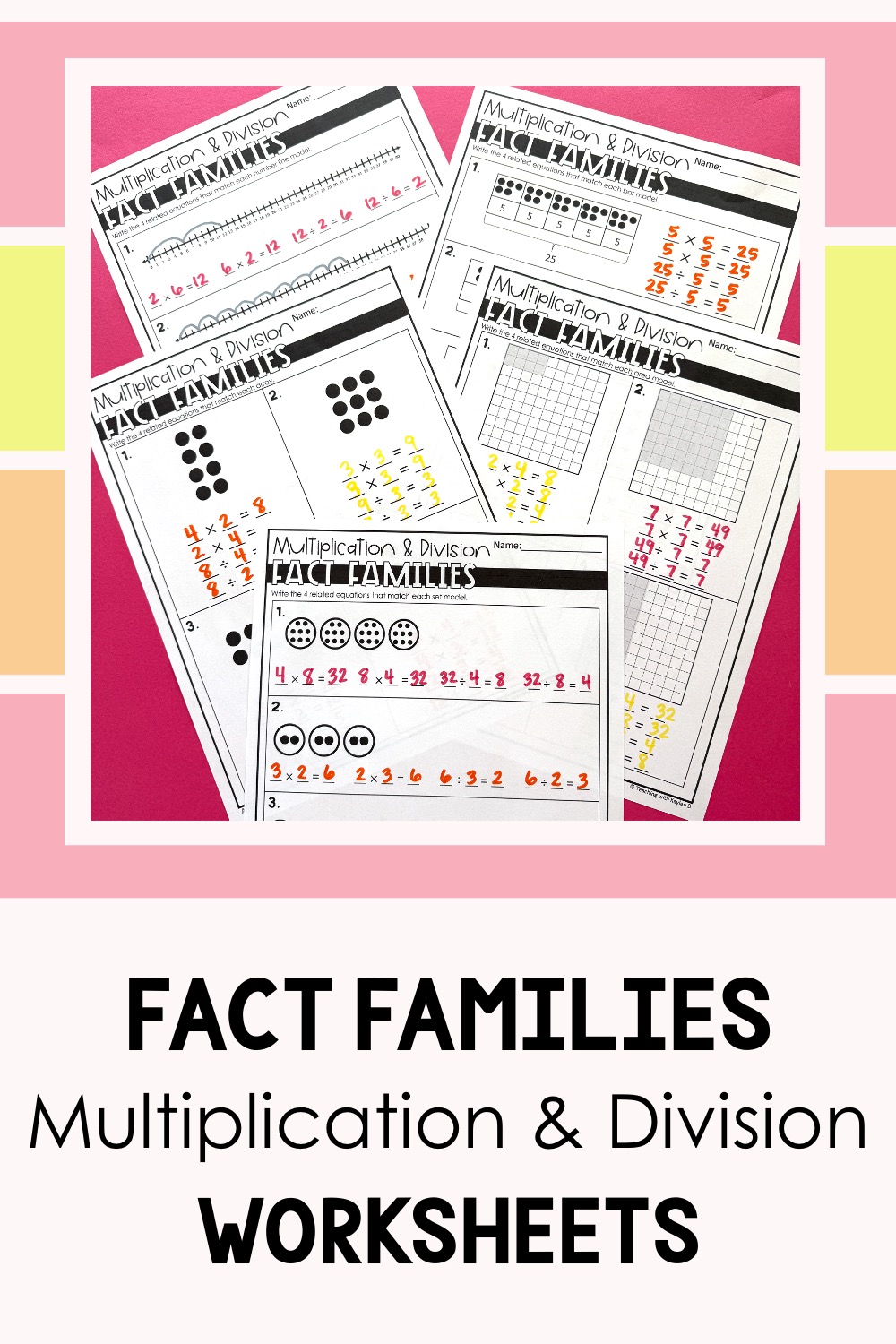
Get students the practice they need with these fact families multiplication and division worksheets.
Students really learn the patterns of multiplication and division fact families from these. They learn that for the multiplication equations they switch around the numbers they are multiplying. And for the division equations that are switching the number they are dividing by and the quotient.
But we also want to give students practice with using multiplication to divide. So I have them complete a worksheet where it has the division equation and then prompts them with a question where they have to think of what multiplied by the number will equal the total.
Then I take away that support of the question prompt, and I have them complete another worksheet where each problem has 2 related equations, a multiplication and a division equation. But there are blanks in the equations so they have to think through the multiplication equation to divide.
These worksheets can be used as independent practice as well. I like to give students a few for guided practice and then a couple for independent practice.
Find these fact families multiplication and division worksheets to use with your students here.
After that, I like to get students extra practice with fact families and using multiplication to divide. So I give them extra practice activities with these. You can use them in centers, or as partner work after independent practice.
Fact Families Multiplication and Division Practice Activities
My three favorite practice activities for families are scoot activities, fact family triangles, and puzzle activities.
Scoot Activities
For scoot activities, this is where I print off task cards and tape them up around our classroom. Then students take a recording sheet and go around to the different task cards around the classroom and write the related facts that match each model.

Give students fact families multiplication practice with these task cards and scoot activities.
I have task card sets for set models, arrays, area models, number line models, bar models, and using multiplication to divide. Find all these sets to use in your classroom here.
But there is a special type of task cards that are so helpful when it comes to students learning multiplication and division fact families. They are fact family triangles.
Fact Family Triangles
Each triangle has the 3 related numbers in each corner of the triangle. In the center of the triangle is space where students write the 4 related equations.

Make practice fun and engaging with these printable multiplication and division fact families.
I like to print these off on colored card stock. Then I laminate them. This makes it so students can write on them with dry-erase markers. Students think this is so fun! But it’s nice for me because once these are made, I can pull them out at any point of the school year to get students extra practice with fact families without making a bunch of copies. Find these multiplication and division fact family triangles here.
But I also like to get students more hands-on activities with fact families. And that is where fact family puzzles come in.
Fact Family Puzzles
These puzzles show the multiplication model and the 4 related equations. I cut apart the model picture and the equations. Then students match the related equations to each model.

Help students learn multiplication fact families with these hands-on puzzles activities.
I have them practice with puzzles for set models, arrays, area models, number line models, bar models, fact family triangles, and using multiplication to divide. Find all of these puzzle activities to use with your students here.
After giving students direct instruction, guided & independent practice, and extra practice activities, I have them complete a quick exit ticket. I will take a look at these after school and take note of students who can use some more practice and instruction.
Find all of the fact family resources I’ve shared in this blog post here.
And that is how I teach multiplication and division fact families to boost fact fluency. You may have some questions like other teachers I have talked to. So here are the answers to frequently asked questions I get from teachers just like you.
Fact Families Multiplication Explained: Frequency Asked Questions
What is a fact family in multiplication and division?
A fact family is a group of related multiplication and division equations that use the same three numbers. For example, if 3 × 4 = 12, then the fact family includes 4 × 3 = 12, 12 ÷ 3 = 4, and 12 ÷ 4 = 3. Teaching these connections helps students understand that multiplication and division are inverse operations.
Why should I teach multiplication and division fact families?
Teaching fact families helps students see patterns and relationships in math facts. When students know one multiplication fact, they automatically know three more division and multiplication facts. This understanding builds fluency and reduces the number of facts they need to memorize.
When should I introduce fact families?
Introduce multiplication and division fact families after students understand the meaning of multiplication and division through models like arrays, bar models, and number lines. Fact families make the most sense once students can visualize how equal groups and repeated addition connect.
How do I teach fact families for multiplication and division?
Start with visual models. Use arrays, area models, or number lines to show how the same set of numbers can make four related equations. Have students fill in part-part-whole diagrams and then write out the matching multiplication and division facts. Finally, guide them to use multiplication to solve unknown division facts.
How can I make learning fact families fun and engaging?
Use hands-on, interactive activities like fact family triangles, puzzles, and scoot games. Students love moving around, matching equations, and seeing the relationships between numbers. Laminate the cards so you can reuse them all year for small groups or centers.
How can fact families help struggling students with fact fluency?
Fact families give struggling students a strategy. Instead of memorizing every single division fact, they can use the multiplication fact they already know to find the answer. This connection builds confidence and helps them think flexibly about numbers.
Where can I find printable multiplication and division fact family worksheets and activities?
You can find ready-to-use fact families multiplication and division worksheets, task cards, puzzles, and fact family triangles in my full resource set here. Each activity is designed to help students see the connections and build lasting fluency with meaning, not rote memorization.
When you teach multiplication and division fact families with meaning, you’re giving students a reliable strategy they can use across all math facts, not just for one worksheet. By helping students see the relationship between multiplication and division, you’re setting them up for long-term fluency and confidence.
Ready to make this easy and effective?
➡ ️ Grab my Fact Families Multiplication and Division Resource for print-and-go worksheets, puzzles, task cards, and more. You can also save money by grabbing it in the full Multiplication and Division Fact Strategies Bundle here.
Want a full roadmap for building fluency from start to finish? Download my free workbook: The 7 Steps to Ensure Math Fact Fluency.
Let’s make fact fluency something your students understand and never forget.